Top AI Development Companies for FinTech, Healthcare, Retail, and EdTech
A bank trying to catch suspicious transactions has little in common with an online store deciding which jacket to show a returning customer.
Add an AI tutor adjusting a lesson after a student makes three mistakes and a healthcare platform extracting information from financial documents, and the phrase “AI development” starts to look almost meaningless on its own.
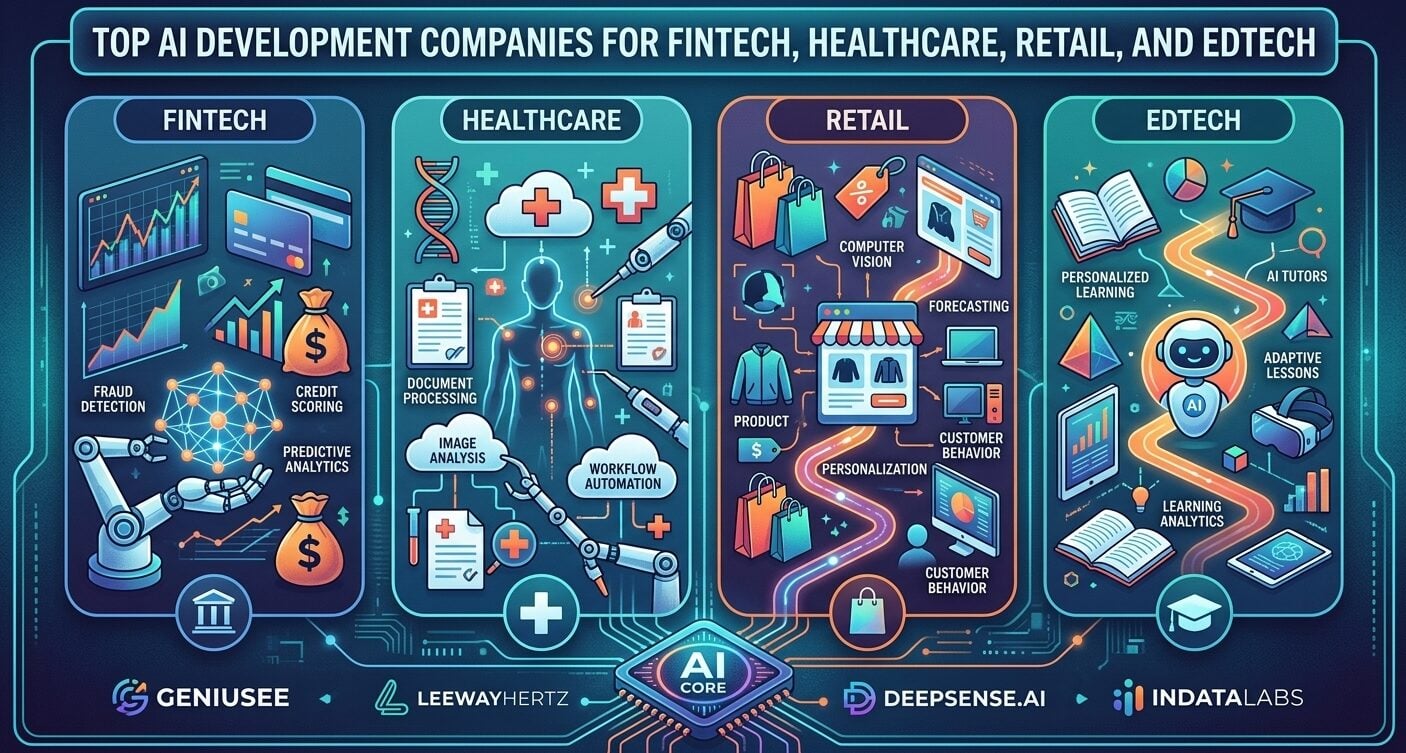
All four businesses may hire an AI team. They will not be asking that team to solve the same engineering problem.
That makes industry context a useful filter when choosing a development partner. Model expertise matters, but so do the data surrounding the model, the software it must connect to, the decisions it is allowed to make, and the people who will use its output.
The companies below approach that challenge from different directions.
1. Geniusee
Geniusee works across the full AI development cycle, from validating the initial use case and preparing data to model development, integration, deployment, and ongoing support.
For companies in FinTech, healthcare, retail, and EdTech, choosing an AI development company means finding a team that can handle this entire path rather than leaving a working model to be turned into a product elsewhere. Geniusee combines AI expertise with the engineering needed to connect new systems to existing business infrastructure.
Its core capabilities include:
- Machine learning and deep learning
- Generative AI and AI agents
- Natural language processing
- Computer vision
- Data engineering
- AI integration
- Enterprise AI solutions
The range is reflected in its project work. Geniusee has developed automated financial-management software for healthcare, an AI-powered learning platform, a real-time computer-vision solution for retail, and a scientific data pipeline designed to process 10,000 research papers.
Its wider expertise also covers fraud detection, credit scoring, predictive analytics, document processing, and workflow automation.
The work around the model is treated as part of development rather than a separate problem. Geniusee can integrate AI with existing databases, APIs, CRMs, ERPs, cloud platforms, and data pipelines.
Before development starts, the team also defines the use case, data readiness, success metrics, and acceptance criteria, including whether custom AI is actually necessary for the problem being solved.
2. LeewayHertz
LeewayHertz is better viewed through the lens of full product engineering than through a single AI specialty.
The company works with artificial intelligence alongside conventional software development, which can be useful when AI represents only one component of a much larger system. A FinTech platform still needs user management and transactional workflows.
An AI-enabled retail product may require mobile interfaces, databases, dashboards, and integrations. An EdTech assistant has to exist somewhere inside the learning experience.
This is where a broader engineering organization can make sense. Instead of treating the model as the finished product, the development scope can include the software required to make that intelligence usable.
LeewayHertz's work covers machine learning, generative AI, enterprise AI, intelligent automation, and custom applications. Businesses considering it are therefore likely to find the strongest fit in projects where AI and wider product development cannot easily be separated.
3. Markovate
A lot of companies arrive at an AI project with a solution already in mind: “We need an LLM.”
Markovate is relevant to that conversation because of its focus on generative AI and AI product development. But the more important question is what the LLM is expected to accomplish.
A support assistant may need retrieval from private documentation. A healthcare workflow might require extraction and classification rather than open-ended generation.
A financial application could combine predictive models with an LLM interface. The visible conversational layer may represent only a small part of the eventual system.
Markovate works across generative AI, machine learning, AI consulting, and custom product development, including projects in industries such as healthcare and FinTech. It is a candidate worth considering when the initial concept is clear but the technical route from concept to usable AI product still needs to be defined.
4. ITRex
ITRex becomes more interesting when the AI project starts inside an organization that already has years of technology behind it.
Established companies rarely have the luxury of designing every system around a new AI initiative. Customer records are already somewhere.
Employees already use internal software. Retail inventory flows through existing systems. Healthcare documents follow established processes. Financial data may cross several applications before reaching the people who need it.
ITRex combines AI with broader software engineering and digital-transformation work. Its capabilities cover machine learning, generative AI, computer vision, intelligent automation, and data engineering.
That combination makes the company relevant for projects where integration is a central engineering problem. The objective might not be to launch a standalone AI application at all. It could be to add prediction, automation, document intelligence, or another AI capability to a workflow employees already use every day.
5. deepsense.ai
Some projects need less product theatre and more serious model engineering.
deepsense.ai occupies that territory. Its work centers heavily on data science and machine learning, with expertise spanning deep learning, NLP, computer vision, generative AI, and MLOps.
That profile can be valuable when the model itself is difficult to build or operate. Think image-heavy healthcare applications, sophisticated classification tasks, proprietary datasets, or systems where teams need to move beyond a straightforward connection to a commercial foundation model.
MLOps is particularly relevant here. Getting a model to perform well during development is one problem; managing versions, monitoring behavior, and keeping the system reliable once real users and changing data enter the picture is another.
For organizations with a technically demanding AI core, deepsense.ai offers a different proposition from a general-purpose software studio that happens to provide AI services.
6. Vention
Vention makes sense from almost the opposite direction.
Its wider engineering organization covers AI and machine learning alongside web, mobile, cloud, and general product development. That can suit companies whose roadmap contains AI without being dominated by it.
Imagine an established EdTech platform adding an intelligent tutor to selected courses. The business still has authentication, payments, student profiles, mobile applications, analytics, and dozens of non-AI features to maintain.
A retailer adding personalization faces a similar situation: the recommendation layer is important, but it remains one piece of the commerce product.
Vention's broader development capacity allows AI work to sit alongside those other engineering needs. This may be particularly useful for growing products that do not want to split conventional development and AI development across completely separate teams.
7. InData Labs
Before asking which model to use, it is sometimes worth opening the database.
InData Labs has a strong data-science orientation, making it particularly relevant to projects where useful AI depends on getting scattered or complicated information into workable shape. Its capabilities include machine learning, NLP, predictive analytics, generative AI, and data engineering.
That foundation has obvious applications across the four industries in this list. Retailers can use historical and behavioral data for forecasting and personalization. Financial businesses may need predictive systems built around large transactional datasets.
EdTech platforms can analyze learning patterns. Healthcare products frequently have to make sense of information collected in very different formats.
The important point is that an algorithm cannot repair every weakness upstream. If records are inconsistent, pipelines are fragile, or useful information remains split between disconnected systems, the data layer may deserve attention before the model does.
InData Labs is therefore particularly worth examining when “build an AI feature” is actually shorthand for “turn our existing data into something the product can use.”
Four industries, four very different tests
A shortlist of companies is only the beginning. The industry should determine what happens next:
- For FinTech, ask how the team handles sensitive financial data, model explainability, audit trails, fraud workflows, access controls, and integration with existing financial infrastructure.
- For healthcare, examine privacy, permissions, traceability, document handling, human oversight, and the consequences of incorrect output.
- In retail, the pressure shifts toward scale, latency, changing catalogs, inventory, recommendations, forecasting, customer behavior, and the economics of running AI across large volumes.
- With EdTech, look beyond whether an AI tutor can generate a convincing answer. The harder questions concern learning context, progress, personalization, feedback, teacher visibility, and when the system should stop answering and involve a human.
These differences are exactly why a generic “AI expertise” badge is not enough.
What should survive the demo?
The most revealing moment in an AI project is rarely the first successful demonstration. It comes later, when messy data arrives, an API changes, users behave unpredictably, response volume increases, or the business asks the system to handle an edge case nobody included in the original presentation.
That is the standard worth using when comparing AI development companies. Look at who will prepare the data, who owns integration, how failures are handled, whether outputs can be monitored, what the internal team receives at handover, and how the system can evolve without being rebuilt from scratch.
FinTech, healthcare, retail, and EdTech may all be investing heavily in AI, but they are not buying the same thing. The useful partner is the one that understands what happens around the model — because that is usually where an impressive AI prototype either becomes a working product or quietly remains a prototype.

Jim's passion for Apple products ignited in 2007 when Steve Jobs introduced the first iPhone. This was a canon event in his life. Noticing a lack of iPad-focused content that is easy to understand even for “tech-noob”, he decided to create Tabletmonkeys in 2011.
Jim continues to share his expertise and passion for tablets, helping his audience as much as he can with his motto “One Swipe at a Time!”