
How Two Cyber Risk Platforms Compare on Coverage and Accuracy
Third-party cyber risk programs depend on timely ratings, evidence, and context that security teams can explain and defend.
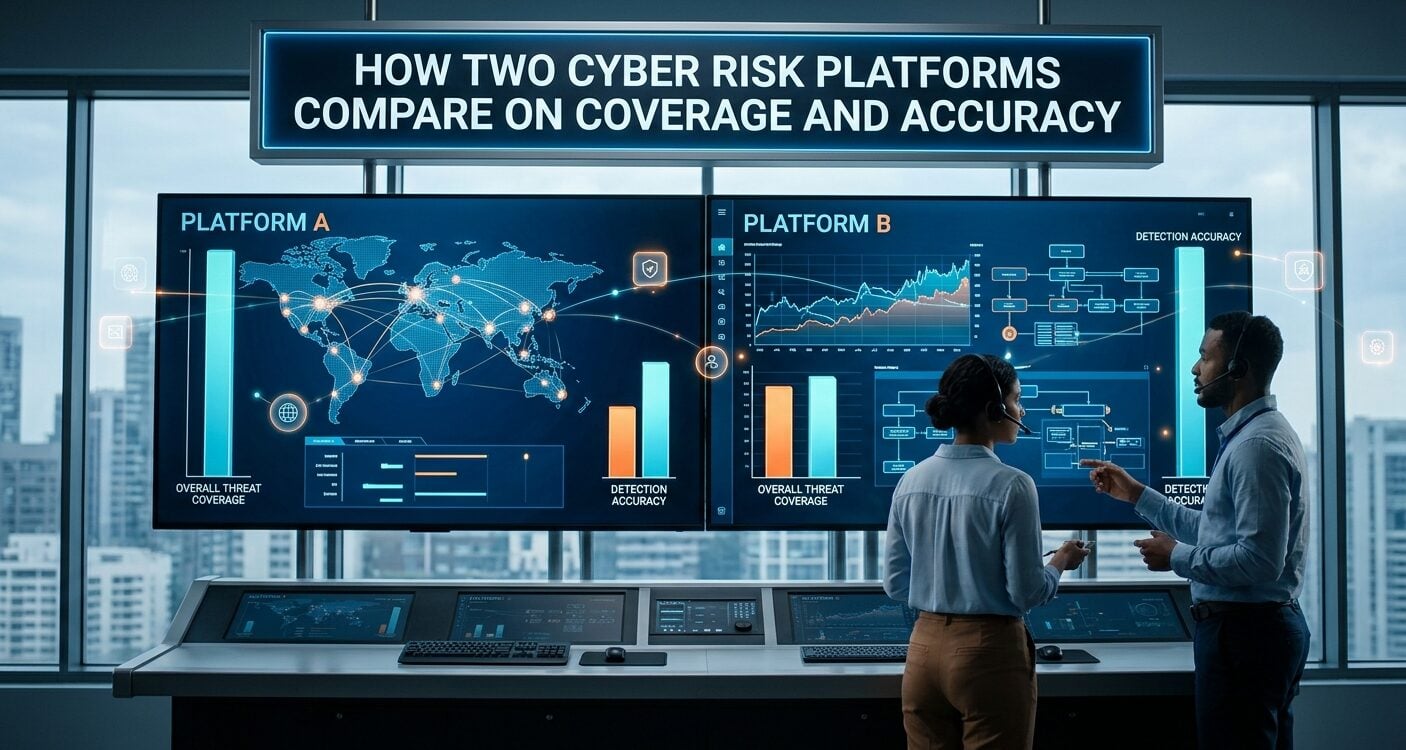
Black Kite and Bitsight share core capabilities, but update frequency, specialized indicators, methodology transparency, and extended dependency visibility affect risk interpretation.
Comparing these areas gives security leaders a basis for judging coverage, rating freshness, and workflow support before choosing a cyber risk platform. The review starts with coverage, then examines accuracy and independent validation.
Coverage Across Third-Party Risk
Both platforms support continuous third-party monitoring, security ratings, AI-powered vendor assessments, fourth-party visibility, supply chain concentration risk, dark web and credential intelligence, and vendor collaboration. Those shared capabilities cover the basic workflow for identifying, assessing, and responding to supplier risk.
For security teams comparing Black Kite vs Bitsight, the difference appears in specialized coverage beyond shared monitoring and assessment functions.
Black Kite lists a Predictive Ransomware Susceptibility Index, adversary and threat-actor susceptibility, and a dedicated Data Breach Index.
Black Kite also lists Open FAIR-based third-party risk quantification and visibility beyond the fourth party; no publicly documented Bitsight equivalent is identified.
Coverage also depends on methodology transparency. Black Kite states that its ratings use transparent, standards-based methods.
The comparison page does not identify a comparable methodology for Bitsight, based on product materials cited there as of September 2026.
Accuracy Depends on Update Frequency
Rating accuracy starts with how often underlying risk information changes. Black Kite reports continuous security rating updates, while Bitsight reports daily updates. That difference matters when a vendor changes exposed services, credentials, vulnerabilities, or other observable conditions between scheduled assessments.
Continuous updates also matter for workflows that depend on current evidence. A score that reflects a recent security change gives analysts a clearer basis for vendor outreach, remediation decisions, and executive reporting. Update frequency does not prove accuracy alone, but it directly affects how current a rating can be.
A practical evaluation should also test how analysts use findings after a rating changes. Forrester's scores give teams a way to compare workflow capabilities beyond dashboard visibility.
Collaboration, remediation prioritization, integrations, and AI adoption affect how quickly analysts can turn findings into documented actions. Specialized indicators matter when security leaders need to prioritize limited review capacity.
A ransomware susceptibility model can distinguish vendors with similar security ratings but different exposure to ransomware conditions. Adversary susceptibility adds another lens by connecting vendor risk assessment with observed threat activity.
The dedicated breach index provides a separate signal for organizations tracking supplier incident history and evaluating recurring exposure. These signals help analysts distinguish broad score differences from specific conditions that require immediate vendor engagement.
Independent customer feedback provides another useful measure. Gartner Peer Insights, as of September 2, 2026, gives Black Kite an overall rating of 4.8 out of 5.0. Bitsight scores 4.5 out of 5.0. Black Kite also records 98% willingness to recommend, compared with 85% for Bitsight.
Capability Depth Beyond the Score
A security rating becomes more useful when analysts can move from a score to an explanation. Black Kite connects ratings with ransomware susceptibility, threat-actor exposure, breach intelligence, and cyber risk quantification. These capabilities provide context for why a vendor deserves attention and what evidence supports the assessment.
For organizations with extended supplier networks, nth-party visibility matters because fourth-party monitoring does not describe the full dependency chain.
Black Kite reports visibility beyond the fourth party, while the comparison identifies no publicly documented Bitsight equivalent. That distinction can affect risk concentration analysis when dependencies extend through multiple vendors.
Independent Validation of Practical Use
The Forrester Wave: Cybersecurity Risk Ratings Platforms, Q2 2026, provides another comparison point. Black Kite scored 5 out of 5 for in-platform collaboration, AI capabilities, and customer AI adoption. Forrester also gave 5 out of 5 for findings prioritization and remediation, integrations and interoperability, and roadmap.
Bitsight scored 3 out of 5 across those same criteria. Forrester defines 5 as Superior, 3 as On Par, and 1 as Below Par. The results therefore show differences in practical capability, especially around collaboration and remediation workflows.
Conclusion
A useful comparison should test whether familiar risk-management functions are backed by current evidence. Continuous updates, specialized risk models, extended dependency visibility, and transparent methodology create meaningful distinctions in coverage and interpretation.
Independent Gartner Peer Insights and Forrester evaluations add external evidence about customer experience and practical capability.
Teams should carefully map required use cases against each documented capability, then verify the underlying evidence before selecting a cyber risk platform.

Jim's passion for Apple products ignited in 2007 when Steve Jobs introduced the first iPhone. This was a canon event in his life. Noticing a lack of iPad-focused content that is easy to understand even for “tech-noob”, he decided to create Tabletmonkeys in 2011.
Jim continues to share his expertise and passion for tablets, helping his audience as much as he can with his motto “One Swipe at a Time!”