
How Quantum Sensing Is Reshaping High-Stakes Operations
Digital transformation was just the warm-up act. Over the past decade, IT and business leaders focused on cloud migration, baseline AI integration, and enterprise connectivity.
Yet, while software capabilities continue to accelerate at a breakneck pace, the physical hardware underlying modern infrastructure is approaching fundamental limits.
Classical sensors—the foundational workhorses monitoring our GPS networks, industrial equipment, defense systems, and medical diagnostics—are running into environmental noise barriers that silicon physics simply cannot overcome.
Enter quantum technology. While public discourse surrounding quantum computing frequently centers on fault-tolerant systems decades away, a quieter, immediate disruption is taking hold across enterprise sectors. Quantum-enhanced physical hardware is moving out of academic laboratories and into live production environments.
For enterprise strategists and technology officers, the shift from classical to quantum-grade physical inputs isn't a theoretical exercise. It represents a paradigm shift in operational precision, predictive accuracy, and data security.
Beyond the Noise Floor: Why Classical Sensing Is Reaching Its Threshold
To understand why the enterprise world is pivoting toward quantum hardware, one must first look at the core bottleneck of classical instrumentation: the signal-to-noise ratio.
Every modern industrial setting relies on precise measurements—whether monitoring magnetic fields in battery manufacturing, maintaining microsecond-level synchronization in distributed financial networks, or navigating environments where satellite connectivity is denied.
Classical sensors measure physical properties using bulk materials. As components shrink and environmental interference increases, these sensors reach a physical limit known as the standard quantum limit (SQL). Beyond this point, increasing sensitivity requires exponential increases in energy, physical space, or computational filtering.
Quantum-grade measurement flips this model entirely. Rather than relying on macro-scale materials, quantum devices measure physical changes at atomic and subatomic levels using three core principles:
- Superposition: Allowing quantum systems to exist in multiple states simultaneously, dramatically increasing measurement sensitivity.
- Entanglement: Linking particle states so that changes in one instantaneously affect another, enabling ultra-precise baseline comparisons.
- Coherence: Maintaining stable quantum states long enough to measure minuscule environmental fluctuations in temperature, electromagnetic fields, or gravity.
By tapping into quantum properties, next-generation instruments can isolate environmental variables with zero baseline drift, unlocking a resolution scale that classical hardware fundamentally cannot touch.
Real-World Enterprise Applications: Where Quantum Hardware Delivers Impact
The business cases for quantum-enhanced measurement are no longer speculative concepts. Forward-looking enterprise IT departments and operations executives are already integrating these capabilities across critical operational verticals.
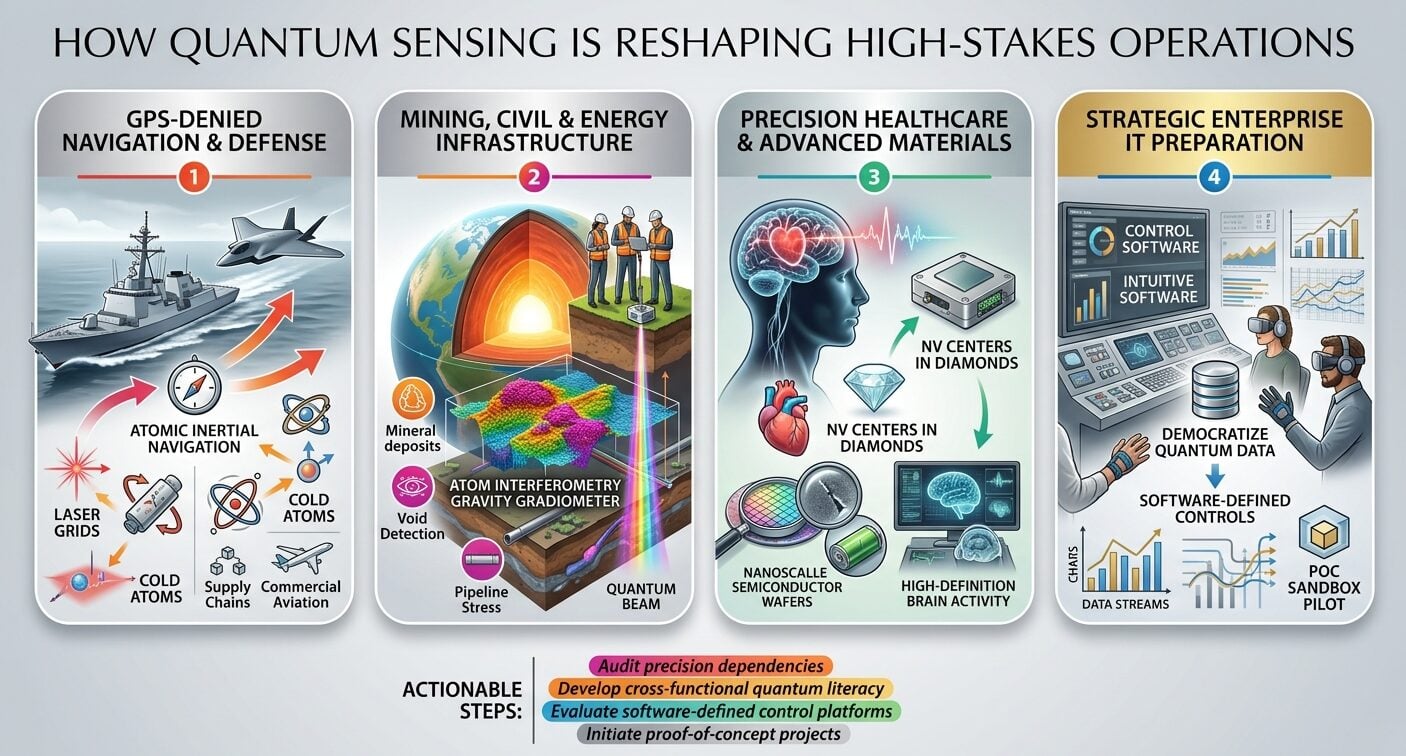
1. GPS-Denied Navigation and Defense Infrastructure
Global supply chains, autonomous maritime fleet operations, and commercial aviation rely heavily on Global Navigation Satellite Systems (GNSS).
However, GPS signals are notoriously fragile—vulnerable to intentional jamming, spoofing, or simple physical obstruction in dense urban canyons and deep-sea environments.
Quantum accelerometers and gyroscopes offer a solution: unspooling absolute inertial navigation systems that do not require external satellite signals.
By measuring the acceleration of ultra-cold atoms trapped in laser grids, these units calculate exact positional changes over extended periods with near-zero cumulative error.
For logistics platforms, autonomous transportation networks, and defense infrastructure, this capability provides complete operational immunity to GPS outages.
2. Micro-Anomalies in Resource Exploration and Civil Infrastructure
Civil engineering and energy sector infrastructure projects spend billions annually mitigating underground hazards, pipeline structural failures, and unmapped geologic formations. Classical gravimeters measure local gravitational pulls, but they are notoriously slow and sensitive to ground vibrations.
Quantum gravity gradiometers measure subtle shifts in gravitational fields using atom interferometry. This allows field teams to mapped subsurface density variations with unprecedented detail.
- Civil Infrastructure: Locating buried utility lines, subterranean voids, and structural sinkholes before breaking ground.
- Mining and Energy: Identifying deep-seated mineral deposits and fluid flows without destructive test drilling.
- Structural Health Monitoring: Detecting micro-fissures in high-stress infrastructure like bridges, dams, and nuclear containment vessels long before structural degradation becomes visible.
3. Precision Healthcare and Advanced Materials
In modern diagnostics, tracking tiny magnetic fields in the human body requires massive, liquid-helium-cooled MRI installations.
Quantum magnetometers—specifically those utilizing nitrogen-vacancy (NV) centers in diamonds—operate comfortably at room temperature while offering nanoscale spatial resolution.
This enables non-invasive, highly detailed mapping of cardiac and brain activity in real time. Beyond health sciences, material engineers utilize these atomic-scale magnetic mappers to spot micro-flaws in semiconductor wafers and next-generation solid-state batteries long before products reach mass assembly lines.
Bridging the Knowledge Gap: Preparing IT Teams for the Quantum Shift
Despite the clear operational upside, the primary bottleneck for enterprise adoption isn't hardware availability—it's talent and software infrastructure.
Quantum physical systems generate complex, high-dimensional datasets that classical IT stacks are ill-equipped to process without specialized middleware and trained personnel.
Historically, hardware engineers required advanced doctorates in atomic physics to calibrate, control, and interpret outputs from these delicate systems. As these devices enter commercial workflows, enterprise technology teams are actively seeking ways to democratize this expertise.
Building in-house quantum fluency requires targeted educational tools that abstract complex quantum physics into intuitive software models.
By leveraging modern educational platforms built for quantum sensing technology, enterprise engineering teams can rapidly bridge the gap between abstract quantum mechanics and practical hardware deployment.
Software-defined control systems now allow traditional IT, data engineering, and operational technology (OT) specialists to calibrate hardware, filter environmental noise, and extract actionable data through familiar software interfaces.
Actionable Steps for Enterprise IT and Operations Leaders
As quantum measurement transitions from experimental labs to commercial deployments, tech executives must prepare their organizations for integration. Preparing today ensures your operations remain resilient as industry standards shift.
- Audit Your High-Precision Dependencies: Identify where your organization relies heavily on precision timing, fine-grained environmental monitoring, or GPS connectivity. Mark areas where measurement noise or signal disruption creates costly operational downtime.
- Develop Cross-Functional Quantum Literacy: Equip your existing workforce with accessible training tools. Upskilling your current software and systems engineers on quantum fundamentals is faster and more cost-effective than competing for scarce doctorate-level quantum talent.
- Evaluate Software-Defined Control Platforms: Focus on quantum hardware solutions that prioritize robust software control layers. Hardware hardware is only as good as the software used to mitigate phase noise and environmental decoherence.
- Initiate Target Proof-of-Concept (PoC) Projects: Identify a single, high-value operational bottleneck—such as subterranean asset mapping or precision timing synchronization—and run a controlled sandbox pilot alongside your classical hardware.
The Strategic Imperative
The transition to quantum-enhanced infrastructure isn't a distant future scenario—it's a present-day engineering evolution.
Just as early adopters of cloud infrastructure and edge computing gained significant operational leads over legacy competitors, organizations that integrate quantum-grade measurement into their tech stacks will set new benchmarks for precision, reliability, and uptime.
For business and IT leaders, the goal isn't to replace your entire technology stack overnight. It's about recognizing where classical inputs limit performance and systematically deploying quantum precision where it delivers the highest yield.

Jim's passion for Apple products ignited in 2007 when Steve Jobs introduced the first iPhone. This was a canon event in his life. Noticing a lack of iPad-focused content that is easy to understand even for “tech-noob”, he decided to create Tabletmonkeys in 2011.
Jim continues to share his expertise and passion for tablets, helping his audience as much as he can with his motto “One Swipe at a Time!”