
How OLED Tablets Are Changing Financial Data Consumption
OLED tablets offer two clear advantages for traders looking to improve their market analysis. OLED is currently the best widely available consumer display technology, and tablets are large enough to view charts clearly but small enough to carry around.
What Is OLED?
An Organic Light-Emitting Diode (OLED) is a type of display panel technology that does not rely on a backlight. This primary characteristic sets it apart from other display technologies.
In a standard LED or LCD display, the pixels handle colour production but require assistance with brightness, and that brightness comes from a backlight. This is a large white panel positioned behind the pixels that provides enough illumination to deliver a decent experience.
OLEDs are different in that each pixel generates its own light and this eliminates the need for a backlight. Because each pixel is self-lit, when the signal indicates that a particular area of the screen should be pure black, the pixels in that area are completely turned off.
This is something other display types cannot achieve, since even a single illuminated pixel requires the backlight to remain active.
As a result, the images from OLED panels are far more colour-accurate than those from other display types. The average person might not be too concerned with the difference in image quality but traders and gamers often find the gap unacceptable.
Advantages of OLED Screens for Financial Data
Here are some of the advantages OLED displays deliver to investors who trade the financial markets.
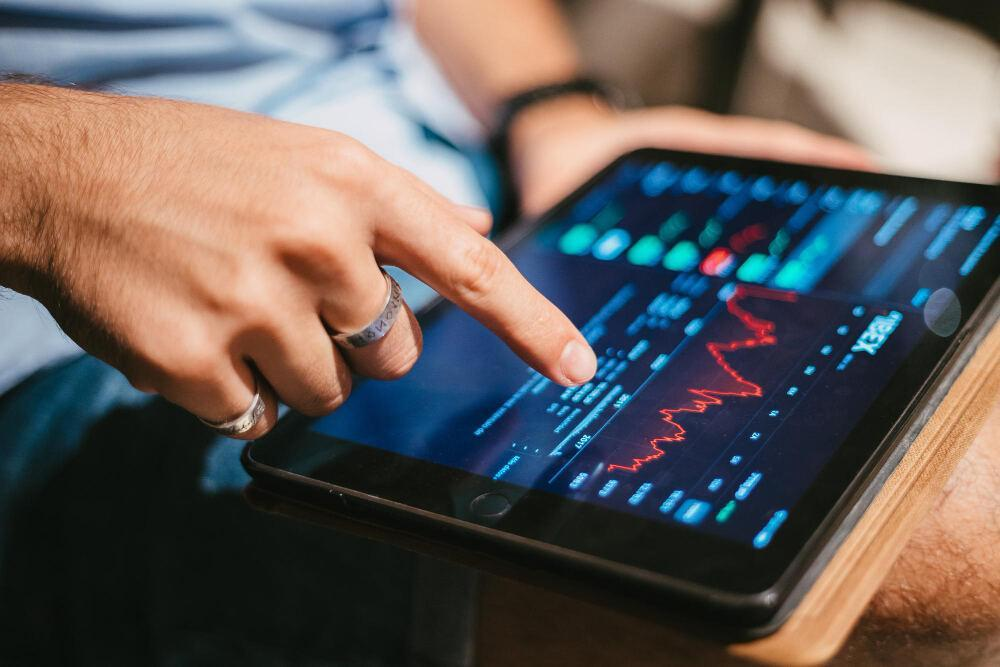
- OLED screens display true black, which creates a contrast ratio that LCDs cannot match. This makes it easier to read financial data, such as charts, at a glance because the visual distinction between elements is sharper.
- OLED panels also reproduce colours more precisely and across a wider gamut than most LCDs. Traders find this appealing because financial dashboards such as candlestick patterns rely heavily on colour to communicate information.
- OLED screens emit roughly 34% less blue light than LCD displays according to Orient Display. Blue light can contribute to eye strain and fatigue during long screen sessions.
- Most financial apps and charting platforms now offer dark mode. On an LCD, dark mode still lights up the entire backlight and tries to block the light where black is needed, which results in a grey-ish black. On an OLED, dark mode pixels are genuinely off.
- OLEDs generally deliver a faster response time compared to other display technologies, which reduces slippage in financial markets.
- Another benefit of OLED displays is that they are flexible, which makes curved and bendable monitors possible.
- OLEDs can be made very thin, which increases their eye appeal and makes them easy to carry around.

Trading and Portfolio Management on the Go
The advantages of OLED technology become even more relevant when combined with the portability of a tablet. While desktop monitors are larger and provide wider display angles, they are limited to home use. A tablet is big enough to convey important chart information and also portable to fit in a bag.
Tablets are also built for touch interaction. Pinching to zoom into a specific section of a chart, swiping between timeframes, tapping on individual candlesticks to see price data and scrolling through watchlists are all more intuitive on a touchscreen than with a mouse.
For investors who use online trading platforms to manage positions on the move, a high-quality OLED tablet can offer a genuinely better experience in many situations.
The combination of portability, touch input and OLED display quality means an investor can review a full dashboard during a commute, check positions over coffee or respond to a market-moving headline within minutes. Battery life on OLED tablets also tends to be strong because pixels displaying dark content draw less power.
For professionals who travel frequently or work across multiple locations, an OLED tablet has become a serious secondary screen alongside a desktop setup.
What the Future Could Bring?
At SID Display Week 2026, held in Los Angeles in early May, LG Display unveiled its third-generation Tandem OLED technology.
The new panels deliver brightness up to 4,500 nits with ultra-low reflectance of just 0.3%, the lowest of any existing display.
LG also demonstrated a 27-inch panel with 5K resolution at 220 PPI using a new RGB stripe structure that improves colour clarity and reduces distortion like colour bleeding and fringing.
For tablets specifically, LG introduced a 16-inch Tandem OLED for portable devices that is thinner and lighter than current panels while extending battery life by up to 2.3 hours.
Samsung continues to push AMOLED forward with brighter panels and improved outdoor readability, and Apple's tandem OLED architecture is expected to expand across more of its product line.
Many experts expect OLED technology to keep improving over the next several years. MicroLED, which uses microscopic LEDs for each pixel without the organic compounds that degrade over time, is widely considered the next major step.
It promises higher brightness, no burn-in risk and longer panel lifespan. But MicroLED remains extremely expensive and is not yet available in tablets.
A Screen Worth Paying Attention To
OLED tablets are not going to replace a solid investment strategy or a disciplined risk management plan. But for the millions of people who consume financial data on a screen every day, the quality of that screen matters more than most realise.
Better contrast means clearer charts. Better colour accuracy means more reliable visual data. The technology has matured to the point where it is a practical tool that improves how financial information is read, interpreted and acted on.

Jim's passion for Apple products ignited in 2007 when Steve Jobs introduced the first iPhone. This was a canon event in his life. Noticing a lack of iPad-focused content that is easy to understand even for “tech-noob”, he decided to create Tabletmonkeys in 2011.
Jim continues to share his expertise and passion for tablets, helping his audience as much as he can with his motto “One Swipe at a Time!”