
RiseGuide: A Solid Alternative for Those Tired of Passive Learning
The global self-improvement market is growing fast, yet most people struggle to turn learning into real personal change. Do you?
According to a meta-analytic review that examines the generation effect, people who generate information (e.g., produce synonyms) after reading remember the information better than they do if they simply read the material. Here’s what that means in my opinion.
The real problem with most personal development platforms is not the lack of information. It is the lack of execution. Many apps teach you concepts, but very few are designed to help you actually apply them in everyday life.

Here's my take on why passive learning often fails, how RiseGuide, an app focused on self-learning, positions itself as a more action-oriented alternative, and what using the app for several weeks actually felt like.
I chose the Communication Mastery Journey, which focuses on improving communication skills and self-confidence. I've always wanted to develop this aspect of myself and see if these skills are truly learnable.
I will also share if it delivers practical value for busy people trying to improve confidence, communication, and social skills.
Most Self-Growth Apps Don’t Actually Change Anything
Let’s be honest for a moment.
If you’re interested in self-development, you already know what you need to change. You likely know more than you apply. You may have watched countless courses on communication, saved articles about confidence, or listened to many podcasts about productivity.
For a short time, this creates in you the feeling of making progress. But when real situations appear, you fall back into the same old, unproductive habits.
That’s the uncomfortable truth – consuming knowledge feels productive, but it does not automatically create lasting behavior change.
Harvard and Stanford researchers Alan MacCormack and Tony Mayo have described what is known as the knowing-doing gap, a concept explaining why both individuals and organizations often fail to turn knowledge into action.
Even when people have access to the right information, training, and strategies, execution often breaks down due to a lack of structure, accountability, or consistent practice.
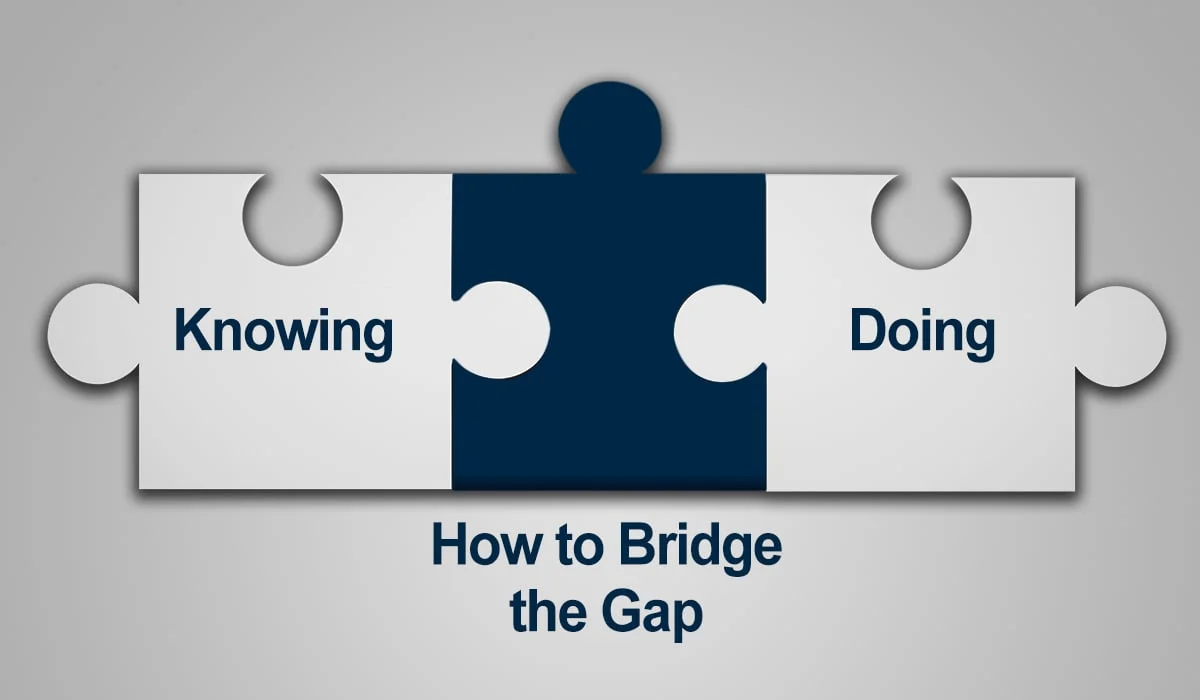
The concept was popularized by Stanford professors Jeffrey Pfeffer and Robert Sutton in 2006 in their research on organizational behavior, where they showed that performance problems often stem not from lack of knowledge but from failure to apply what is already known.
And this explains something important – why so many people feel stuck despite constant learning.
Many self-improvement platforms are built around engagement metrics. They want users watching videos, completing modules, and staying inside the app for as long as possible. That business model rewards consumption rather than execution.
But real improvement rarely happens while watching videos.
It happens when you try something uncomfortable for the first time. When you change behavior slightly and, by doing that, show yourself that you're a person capable of change. When you repeat small actions consistently.
That realization changed how I evaluate self-learning tools. Instead of asking “what will I learn?”, I started asking “what will this tool have me do differently?”. That is exactly where I encountered RiseGuide and found it to be more useful than plenty of other apps I’ve tried.
What Is RiseGuide and How It Works?
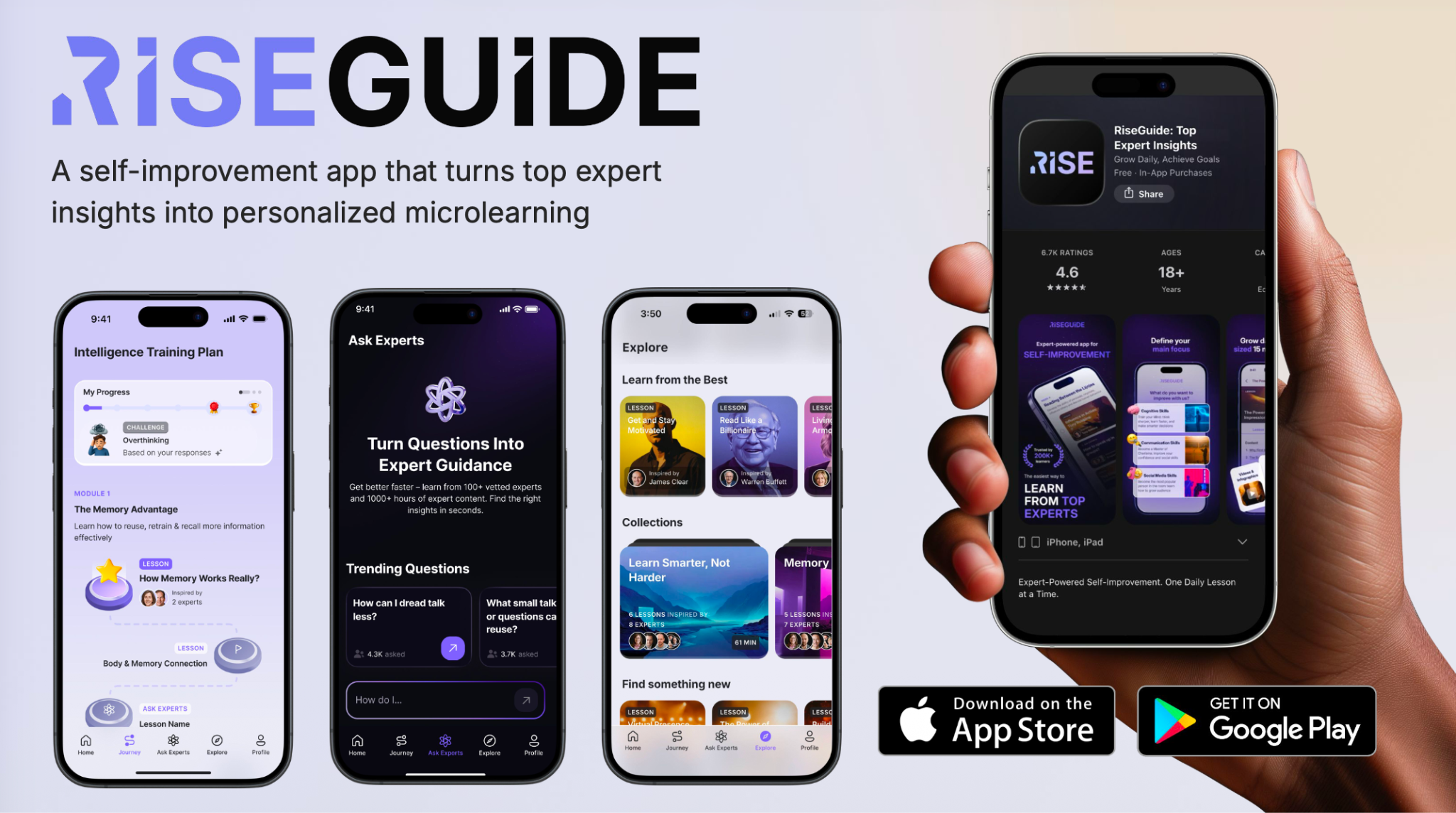
So what exactly is RiseGuide?
In simple terms, it is a personal development app structured around guided improvement journeys rather than open content libraries. Instead of offering hundreds of disconnected courses, it organizes learning into structured paths focused on practical skill building.
According to the official RiseGuide website, the platform focuses on helping users improve their communication skills and cognitive abilities thanks to behavioral exercises, structured routines, and guided development rather than long theoretical lessons.
Here’s where the experience feels different.
Instead of asking you to choose what to learn next, the app presents daily lessons. They usually combine a brief explanation of the concept with an exercise and special practice tools.
This design removes one of the biggest barriers in self-improvement: decision fatigue.
Psychology research from the American Psychological Association (APA) shows that too many choices reduce follow-through because decision-making itself consumes mental energy.
RiseGuide simplifies this process by narrowing the focus to one step at a time. You open the app, see the next lesson, and complete it. There is very little to no planning required.
For busy users like me, this matters more than it might seem at first. Many professionals do not fail at self-development because of a lack of motivation. They fail because improvement feels too time-consuming or complicated to maintain consistently.
By limiting daily activities to manageable exercises (just 10-15 min each), RiseGuide fits into realistic schedules of regular people.
My Experience Using RiseGuide for 3 Weeks
First Impression
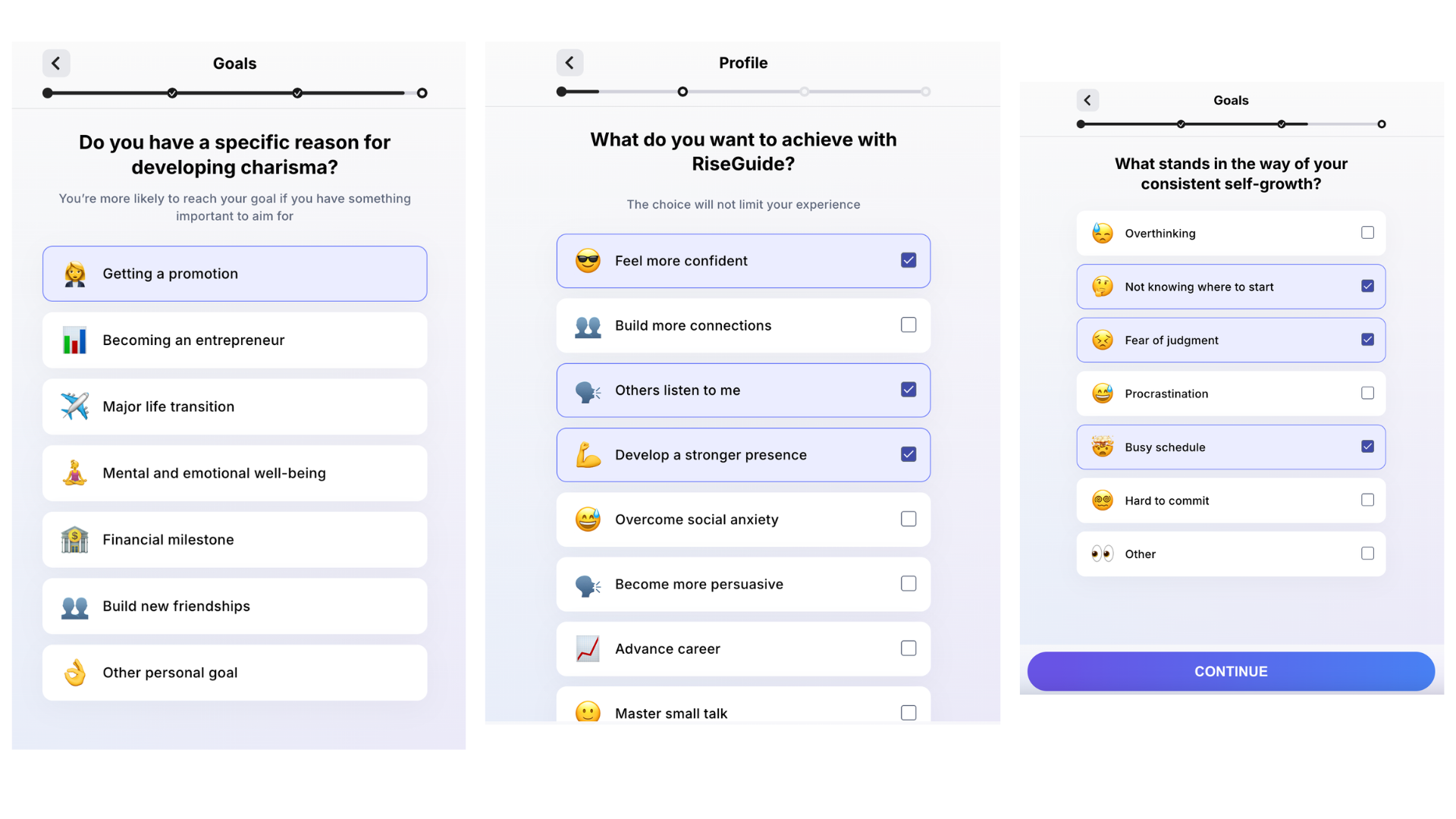
My first impression was how focused on communication the experience felt. The onboarding process did not overwhelm me with options.
Instead, it asked some info about me, what I wanted to improve, and suggested a structured path focused on my specific learning goals.
The interface follows the same philosophy. There is no large marketplace of courses competing for attention. Instead, the design keeps the focus on progress within one journey, the Home tab of today’s lesson to keep me on track, and useful features like SEEK to allow me to explore more.
As we’ve already discussed earlier, here’s why this matters:
Too many options often lead to overload and inaction. When users must constantly decide what to improve, they often postpone improvement entirely and start to self-sabotage (and eventually abandon the idea entirely). RiseGuide avoids this by creating a clear sequence of steps that’s easy to follow.
My initial reaction was not excitement but – a relief? It felt like the app removed unnecessary complexity.
Week 1: Getting Into the Habit
The first week focused mostly on building a base of confidence and a habit of opening the app each day. The tasks I faced while learning about the foundation of charisma and the secrets of small talk were small enough that completing them did not feel like a major commitment.
For example, short voice exercises to sound more grounded and stop mumbling, or training awareness of my posture while in conversations.
Starting required very little motivation.
For me, it’s easier to maintain smaller actions because they lower psychological resistance.
By keeping exercises manageable, the app made it easier to show up daily. Instead of waiting for motivation, I simply followed the structure.
Week 2–3: Where It Gets Real
The second and third weeks were more interesting. This is usually the point where I abandon most learning apps (as probably you do, too). The novelty disappears, and consistency becomes difficult, and I find about a million excuses for why not to do it.
But this time, something different happened with RiseGuide.
Because the system was already integrated into my daily routine, continuing required less effort than starting something new.
The themes were quite interesting too – authority and leadership instructions, which encouraged real-world application, such as adjusting speaking skills before meetings or maintaining confident eye contact with colleagues.
At this stage, the app began to feel less like a learning platform and more like a behavioral training system to me. Instead of thinking about improvement abstractly, I was applying small adjustments regularly.
Can’t wait to see what the next module has for me, as it has the theme I’m very interested in – public speaking.
Why RiseGuide Feels Different From Typical Learning Apps?
Let’s step back and look at the bigger difference.
Most online learning platforms measure progress by content completion. If you finish the videos, you have succeeded. If you complete the lessons, you will improve.
RiseGuide uses a different model, in my opinion.
Progress is measured by completed actions rather than completed content – and in retrospect, these small actions compound like interest.
This may seem like a small distinction, but it changed my success rate significantly. Instead of focusing on knowledge accumulation, the platform encouraged me to repeat my new skills of confident speaking and interesting storytelling and “crystallise” them until they became second nature.
For people who already know they should improve but struggle with follow-through, this approach may be more valuable than additional educational content.
What Actually Works (And Why)?
Several design choices appear to contribute to the way this platform became effective for me.
First, the size of the tasks matters. Smaller activities reduce procrastination because they feel manageable.
Second, the structured format reduces friction. Instead of searching for relevant material, I just follow a guided sequence. This small thing eliminates wasted effort and helps maintain momentum.
Third, the emphasis on practical exercises reinforces learning through application. Instead of understanding a concept theoretically, I can test it in realistic scenarios immediately.
The biggest benefit, however, may be psychological.
Completing small daily tasks creates a sense of progress. This sense of progress encourages continuation. Over time, these small completions can shift how we see ourselves, from passive learners to active participants in our own improvement.
That shift may be more important than any single exercise.
Where RiseGuide Falls Short?
No platform is perfect, and I found some limitations in RiseGuide that are worth noting.
Users with advanced knowledge of psychology or communication may find some of the early exercises too basic. The app appears to be designed primarily for people building foundational skills rather than for experts refining advanced techniques.
The structure may also feel repetitive to some users, because all lessons are designed alike and have a similar structure. However, repetition is often necessary for behavior change, even if it feels less engaging than new content.
Another important limitation I must mention is personal responsibility.
As with any self-paced tool, RiseGuide provides structure, but it cannot enforce action. Users who skip exercises or avoid real-world application and accountability will likely see limited benefit. Like any training system, results depend heavily on an individual’s willingness to show up and do things differently.
Who RiseGuide Is Actually For?
Based on my experience, RiseGuide appears most useful for a specific type of user.
I can only say for myself, but it works well for busy professionals who want structured improvement without spending hours studying theory. It may also benefit introverts looking to improve communication skills or individuals who feel stuck between knowing what to do and actually doing it.
It is particularly suitable for people who want clear direction rather than open exploration in self learning.
However, it may not be ideal for users seeking deep theoretical understanding, therapy-style coaching, or entertainment-driven learning experiences. Those looking for detailed academic material may prefer traditional course platforms.
RiseGuide works best when viewed as a dynamic helping tool, as long as you supplement it with consistent practice and personal accountability for achieving your goal.
Did It Actually Change Anything?
The changes I experienced were not dramatic, but they were noticeable to my peers and me.
After several weeks, I became more aware of how I approached conversations. I paid more attention to how I introduced myself. I became slightly more deliberate in communication situations rather than relying entirely on habit.
Perhaps the most important change was consistency.
Instead of thinking about improvement occasionally, I was practicing it regularly. That shift alone made self-development feel more realistic and less abstract. Is it the confidence I feel now? I guess so.
The biggest takeaway was simple.
Improvement felt less like an idea and more like a routine. And routines are what usually create long-term change.
Final Verdict — Is RiseGuide Worth It?
So, is RiseGuide worth using?
That depends on what you expect.
If you are looking for entertainment, deep theory, or inspirational content, many platforms may suit you better in that case.
But if your goal is practical improvement through small daily actions, RiseGuide offers a different approach that may feel refreshing compared to traditional learning apps.
It does not promise transformation overnight, and it does not rely on motivational hype. Instead, it focuses on structured, repeatable actions that may help you build a better version of you over time.
In a market full of platforms designed for passive consumption, an app built around execution stands out. And for users who are tired of learning without doing, that difference may be exactly what makes it worth trying.

Jim's passion for Apple products ignited in 2007 when Steve Jobs introduced the first iPhone. This was a canon event in his life. Noticing a lack of iPad-focused content that is easy to understand even for “tech-noob”, he decided to create Tabletmonkeys in 2011.
Jim continues to share his expertise and passion for tablets, helping his audience as much as he can with his motto “One Swipe at a Time!”