
AI-Powered Test Automation for Workday ERP Implementations
Implementations of Workday enterprise resource planning are significant organizational expenditures that necessitate careful validation to guarantee business processes operate as intended. Payroll computations, financial operations, human resource management, and various departmental integrated workflows provide a glimpse of testing complexity. Quality risks arise from traditional manual testing's inability to provide comprehensive coverage within Workday ERP implementation schedules.
Workday testing is transformed by artificial intelligence through intelligent automation that expedites deployment schedules, fully validates setups, and dynamically adjusts to modifications. Organizations can reduce deployment risk and obtain effective results by comprehending AI-powered testing methodologies.
-
Workday-Specific Testing Complexity
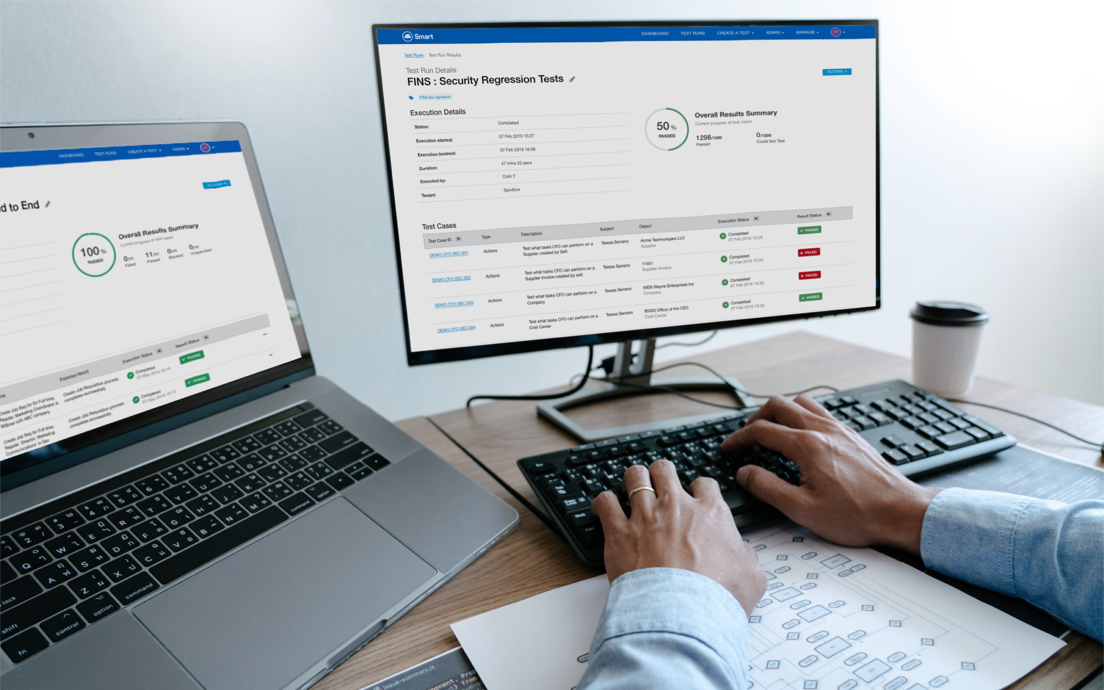
Complex business process frameworks covering hiring, pay, benefits administration, time tracking, expenditure management, financial accounting, procurement, and reporting capabilities are found in Workday workplaces. Each process consists of multiple calculation engines, approval workflows, and security setups, and integration touchpoints, which must be validated.
Organizations implement tenant-specific customizations which include calculated fields, business rules, custom reports, and connection to external systems which require a lot of testing. Regression validation is necessary to ensure that Workday's ongoing changes preserve its current functionality.
-
Intelligent Business Process Validation
By simulating realistic user journeys across various roles along with scenarios without the need for manual script development, AI-powered testing seamlessly validates Workday business processes from start to finish. By analyzing business process documentation, machine learning finds important workflows that need validation coverage and automatically creates the necessary test cases.
While maintaining data accuracy throughout, intelligent systems carry out intricate scenarios involving employment processes, pay adjustments, benefits enrollment, performance evaluations, financial transactions, and approval chains.
-
Automated Calculation and Rule Verification
Payroll amounts, tax withholdings, benefit premiums, compensation changes, and financial computations based on intricate business regulations are all determined by Workday's many calculation engines.
By automatically creating a variety of test data scenarios that encompass edge situations, boundary conditions, and regulatory variances, AI-driven testing verifies computation correctness. Based on complexity analysis and past fault trends, machine learning finds input combinations that most likely show computation problems.
-
Integration Testing Across Connected Systems

Integrations with payroll providers, benefits administrators, time tracking systems, recruiting platforms, and financial applications are necessary for Workday implementations, which are rarely found in isolation. AI-powered testing ensures reliable information transfers without human intervention by validating data flows between Workday and external systems.
In order to validate system performance under pressure, machine learning produces realistic integration test data that matches production volumes and characteristics. Throughout testing, intelligent systems continuously monitor integration points to identify faults in data transformation, malfunctions, or timing problems that affect reliability.
-
Regression Testing for Continuous Updates
Workday improves features on a regular basis throughout the year. So, businesses must ensure that new Workday releases don't interfere with pre-existing configurations or modifications. After every Workday update, AI-driven regression testing automatically re-validates crucial business processes without the need to manually construct test suites.
Machine learning determines which configurations have altered during updates, concentrating testing on areas that might be impacted while ignoring functionality that hasn't changed. Test validity is maintained between versions by self-healing test capabilities that adjust to interface changes Workday introduces. Through effective regression validation that safeguards investments and makes use of Workday's ongoing platform enhancements, organizations preserve operational continuity.
Conclusion
Through intelligent business process validation, automated calculation verification, thorough integration testing, and effective regression capabilities, AI-powered test automation tackles the complexity of Workday deployment.
AI-powered test automation is no longer optional for successful Workday ERP implementations, it’s essential. By combining speed, and intelligence, as well as adaptability, AI powered test automation ensures quality at scale while reducing risk and timelines. Opkey leads this transformation with an agentic AI-native platform that identifies what to test, generates and maintains automated tests, predicts defects, along with securing enterprise data end to end.
Leveraging Machine Learning, NLP, and Generative AI, Opkey helps organizations test faster, and migrate smarter, along with deployment with confidence. The result is reliable ERP performance, accelerated outcomes, and continuous innovation across the enterprise.

Jim's passion for Apple products ignited in 2007 when Steve Jobs introduced the first iPhone. This was a canon event in his life. Noticing a lack of iPad-focused content that is easy to understand even for “tech-noob”, he decided to create Tabletmonkeys in 2011.
Jim continues to share his expertise and passion for tablets, helping his audience as much as he can with his motto “One Swipe at a Time!”