
Understanding content://cz.mobilesoft.appblock.fileprovider/cache/blank.html: Complete Breakdown
Android users occasionally discover unusual links on their devices. The address content://cz.mobilesoft.appblock.fileprovider/cache/blank.html represents one such example. This technical string appears mysterious initially. However, its function remains straightforward and harmless.
Decoding This Technical Address
The identifier content://cz.mobilesoft.appblock.fileprovider/cache/blank.html belongs to Android's content provider system.
These addresses enable applications to share information securely. The “content” prefix signals that Android's content provider framework manages this resource.
This particular address connects to AppBlock application files. It references a location where temporary data gets stored. Users need not worry about encountering this string during normal device usage.
Breaking Down Each Component
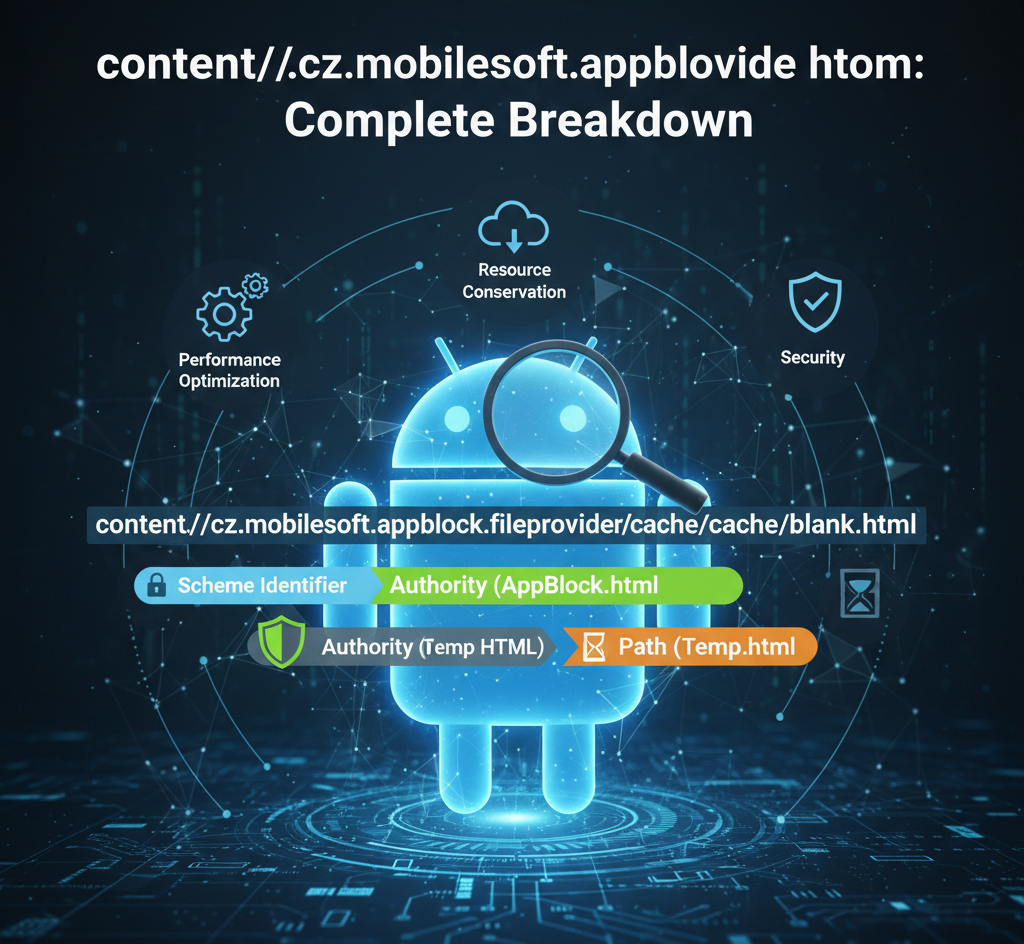
Understanding each segment helps clarify the overall structure. Here's how content://cz.mobilesoft.appblock.fileprovider/cache/blank.html breaks down:
| Component | Description | Function |
| content:// | Scheme identifier | Signals Android content provider usage |
| cz.mobilesoft.appblock.fileprovider | Authority section | Identifies AppBlock's file management system |
| /cache/blank.html | Path segment | Points to temporary HTML document location |
The Authority Component Explained
The authority “cz.mobilesoft.appblock.fileprovider” identifies AppBlock's FileProvider. Android FileProviders enable secure file sharing between applications. They prevent unauthorized access to sensitive information.
AppBlock implements its FileProvider to manage temporary files. This system protects user privacy while allowing necessary operations. The FileProvider acts as a controlled gateway for data exchange.
Purpose Behind The Path Segment
The path “/cache/blank.html” directs to an empty HTML document. This file serves as a temporary placeholder. Applications create such files for various technical reasons.
The cache directory stores temporary information. Files here don't remain permanently. They assist with smooth application performance without consuming excessive storage space.
Why Empty HTML Files Matter?
AppBlock employs this empty HTML document for operational efficiency. It provides a lightweight solution when content references become necessary. The blank file prevents errors during certain processes.
Here's why this approach benefits users:
| Benefit | Impact |
| Performance optimization | Faster app response times |
| Resource conservation | Minimal storage usage |
| Error prevention | Smooth user experience |
| Simplified development | Easier maintenance |
Security Implications
Content providers in Android include built-in protection mechanisms. The content://cz.mobilesoft.appblock.fileprovider/cache/blank.html address operates within these safety parameters. Only authorized applications can access such resources.
Android enforces strict permission requirements. Apps cannot access FileProvider content without explicit authorization. This architecture safeguards user information effectively.
Common Encounter Scenarios
Users might notice content://cz.mobilesoft.appblock.fileprovider/cache/blank.html in several situations:
During application installation or updates, temporary files get generated. Developers encounter these addresses when debugging applications. AppBlock users see such references within cache management features.
None of these scenarios indicates problems. The presence of this address simply confirms normal application operations.
Risk Assessment
Many users worry when encountering unfamiliar technical strings. However, content://cz.mobilesoft.appblock.fileprovider/cache/blank.html poses zero threat. It represents standard Android functionality.
The empty HTML file contains nothing harmful. It exists solely for technical purposes within AppBlock's framework. Android's security architecture prevents misuse of such resources.
Users downloading applications from trusted sources face minimal risk. Google Play Store implements verification procedures. These checks ensure downloaded apps meet security standards.
Final Verdict
The message displaying content://cz.mobilesoft.appblock.fileprovider/cache/blank.html requires no action. It's completely safe. Users can ignore this technical reference confidently.
Android applications routinely create temporary files during operations. This particular address simply identifies one such file. The empty HTML document assists AppBlock's internal processes without affecting device security.
Understanding these technical elements helps users feel more comfortable. Knowledge removes unnecessary concerns about normal system operations. Content://cz.mobilesoft.appblock.fileprovider/cache/blank.html represents just another behind-the-scenes component keeping your applications running smoothly.

Jim's passion for Apple products ignited in 2007 when Steve Jobs introduced the first iPhone. This was a canon event in his life. Noticing a lack of iPad-focused content that is easy to understand even for “tech-noob”, he decided to create Tabletmonkeys in 2011.
Jim continues to share his expertise and passion for tablets, helping his audience as much as he can with his motto “One Swipe at a Time!”